Delaware’s First Cohort of Doctoral Nurse Anesthesiology Students Begins Training at ChristianaCare
ChristianaCare plays a leading role in a partnership building a homegrown pipeline for Delaware’s operating rooms


ChristianaCare plays a leading role in a partnership building a homegrown pipeline for Delaware’s operating rooms
 Sarah Sorowice, BSN, RN, left, and her classmates learn an airway management technique from Andrew Dilks, DNP, CRNA.
 Jacqueline Mainwaring, PhD, DNP, CRNA, director of the Delaware Nurse Anesthesiology Program, walks medical student Alison Lorenz, RN, through a ventilation technique in ChristianaCare's VEST Center at the Newark Campus.
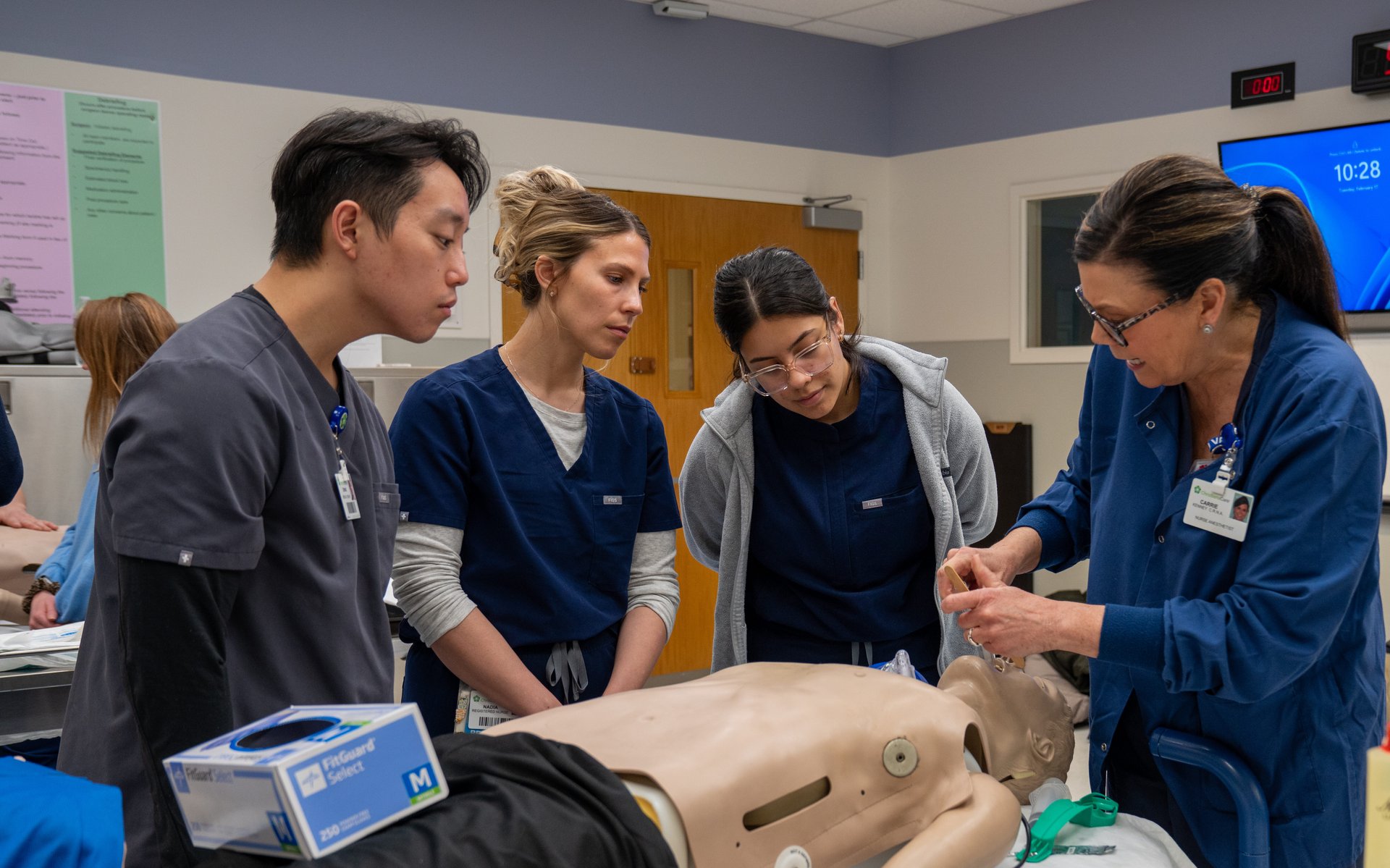
 Cathy Loughead, MS, CRNA, instructs students in Delaware's first class of doctoral nurse anesthesiology students at ChristianaCare's Virtual Education and Simulation Training Center.
 Corie Dalton, BSN, RN, CCRN, a student in the Delaware Nurse Anesthesiology Program, practices a laryngoscopy technique in ChristianaCare's Virtual Education and Simulation Training Center.
 ChristianaCare's Virtual Education and Simulation Training Center is a 9,000-square-foot facility on the Newark campus that's designed to replicate a working hospital environment, with a trauma bay, ICU, operating room and standardized patient rooms.